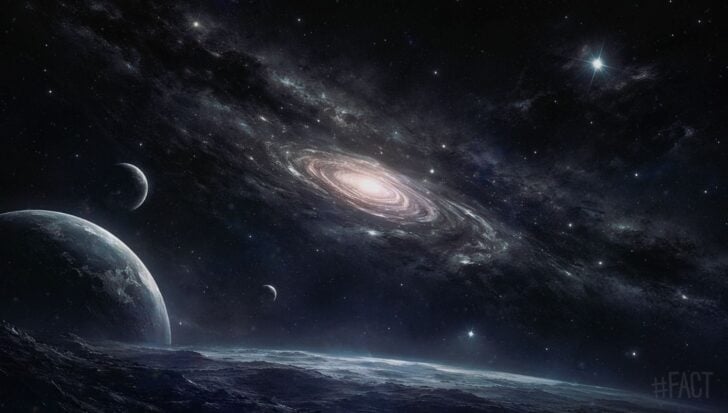
In Chinese, Japanese, Korean, and Vietnamese, Uranus is literally translated as the “sky king star.”
The world’s first space station was the Soviet Salyut 1, which spent 175 days in orbit in 1971.
Three men from Yemen tried to sue NASA in 1997 for exploring Mars without their approval, claiming they inherited the red planet from their ancestors over 3,000 years ago.
The brightest asteroid visible from Earth is 4 Vesta, which can occasionally be seen with the naked eye.
Uranus has wind. The planet’s wind speeds can reach up to 560 miles per hour (900 km/h).
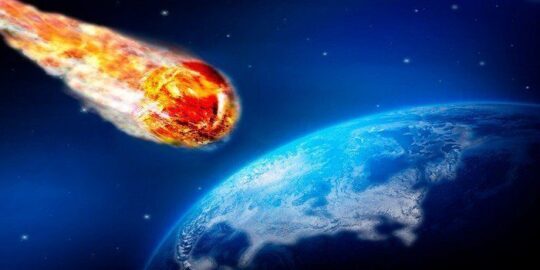
About once a year, a meteor the size of a small car burns up in Earth’s atmosphere.
Our galaxy, the Milky Way, is slowly being deformed and twisted apart by a neighboring galaxy, the Large Magellanic Cloud.
All space telescopes take photos in black and white. Astronomers colorize them afterward by assigning colors to different wavelengths to reveal details like composition and temperature.
The Big Dipper is classified as a recognizable cluster of stars, known as an asterism, rather than a constellation, as it is part of the much larger Ursa Major constellation.
Earth’s diameter is about 3.7 times that of the Moon, but it has roughly 50 times more volume and 81 times more mass.
Up to half of Earth’s water formed before the Sun, originating from interstellar ices in the molecular cloud that birthed our solar system.
Neutron stars can spin up to 43,000 times per minute. That’s over 700 times per second!
Pluto is a frozen wasteland, but it’s not just covered in frozen water. The dwarf planet is also made up of frozen nitrogen, carbon monoxide, and methane.
Earth is the only planet in the Solar System with just one moon.
With a width of 738 million miles (1.2 billion kilometers), the largest known star in the Milky Way is UY Scuti, a red supergiant star that’s 1,700 times larger than the Sun.
The James Webb Space Telescope, launched in December 2021, cost $10 billion, a figure that includes design, construction, and a portion of the operating costs.
Iapetus, one of Saturn’s many moons, is perfectly two-tone: one half is bright and reflective, and the other half is dark and mysterious.
Neptune is the next largest planet after Earth, but the two differ greatly in size, as Neptune’s diameter is nearly four times that of Earth.
Besides Earth, Mars has more spacecraft operating on and around it than any other planet.
The Omega Nebula, measuring 15 light-years across, is one of the largest star-forming regions in the Milky Way.
When looked at from space, stars don’t twinkle, as there’s no atmosphere in the way to distort their light.
A super-Earth is a planet with less mass than icy giants such as Uranus or Neptune but more mass than Earth.
Neptune is home to the strongest winds in the entire Solar System, with speeds clocking in as fast as 1,200 miles per hour (1,930 km/h).
The south pole of Enceladus, one of Saturn’s moons, is covered in long, parallel fissures nicknamed “tiger stripes.”
The largest known structure in the universe is the Hercules-Corona Borealis Great Wall, a vast cosmic filament composed of galaxies that spans over 10 billion light-years.
The smallest asteroid recognized by NASA is the 6-foot (2 m) wide asteroid 2015 TC25.
The largest known intact meteorite is Hoba, a 66-ton (60 metric tons) hunk of iron. It landed on Earth approximately 80,000 years ago in Namibia and has remained in place ever since.
The Orion Nebula, in the Orion constellation, is a giant cloud of gas that’s constantly forming new stars.
The International Astronomical Union (IAU) is the governing body that decides on the names of stars.
Galaxies are just giant collections of gas, dust, stars, and planets held together by gravity.
The wind on Venus can often reach speeds as high as 450 mph (724 km/h).
Telescopes in space work far better and are much more accurate than Earth-based telescopes, as their vision is not blurred by Earth’s atmosphere.
Saturn has an enormous hexagonal storm at its north pole that’s been raging away ever since it was first discovered by NASA’s Voyager mission in 1981.
The International Space Station was launched into orbit piece by piece and assembled there, as no single rocket was powerful enough to carry the entire structure into orbit at once.
The clouds on Venus are made up of vaporized heavy metal compounds, so when it snows, it snows heavy metal.
Approximately seven new stars are formed each year in the Milky Way.
If a meteoroid makes it through Earth’s atmosphere and lands on Earth, it’s called a meteorite. Meteorites are only a fraction in size compared to the original meteoroid.
Every 248 years, Pluto spends 20 years closer to the Sun than Neptune.
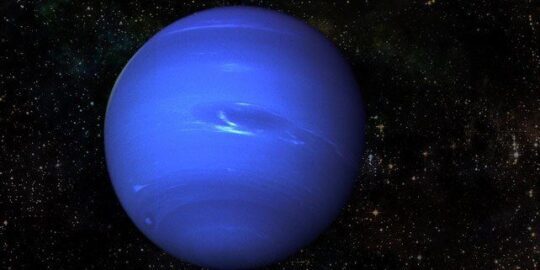
Neptune doesn’t look blue because of water; the ice giant gains its beautiful blue hue from the methane in its atmosphere.
The U.S. flags placed on the Moon by NASA have likely all been bleached white by years of solar radiation.
There’s about as much space on the International Space Station as a five-bedroom house.
Venus is brightest when it’s a crescent and relatively close to Earth, about a month before or after passing between Earth and the Sun.
NASA’s Voyager space probes each carried record players and a golden record containing greetings in Earth’s languages and a variety of sounds from Earth.
There’s water on the Moon, but it’s not in liquid form. Instead, water ice is found all over the Moon’s surface, with the highest concentrations at its permanently shadowed poles.
Saturn’s moon Iapetus has an orbit of 79 Earth days.
The James Webb Space Telescope was the first telescope to detect carbon dioxide in an exoplanet’s atmosphere.
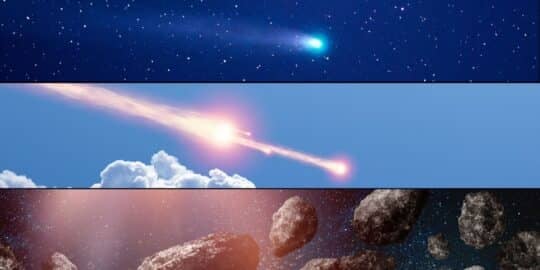
Asteroids, comets, and meteoroids are different: Asteroids are rocky, comets are made of ice and dust, and meteoroids are fragments of either that were created in collisions.
Mars travels around the Sun at an average speed of 14.91 miles per second (24 km/s).
Some of the Apollo astronauts had the ingenious idea to stick Velcro inside their helmets so they could scratch their noses when they got itchy while in their spacesuits.
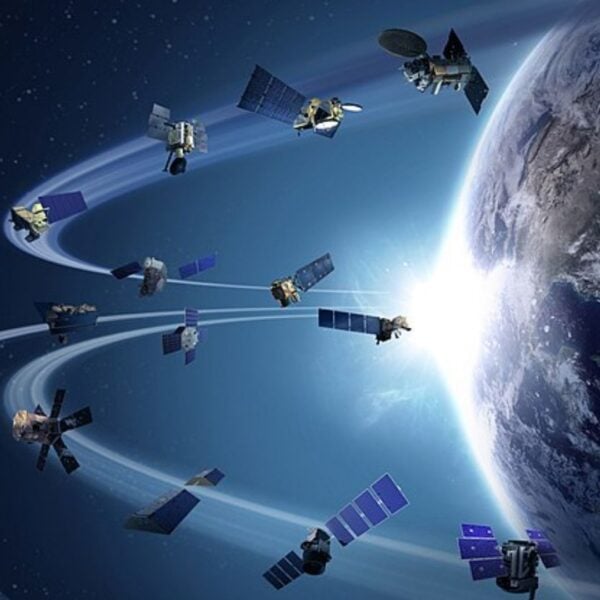
One day on Venus is 243 Earth days, while a year on Venus is 225 Earth days, making Venus’s days longer than its years!
An exoplanet is a planet that orbits a star other than our Sun.
Due to Earth’s gravity, the Moon has a slight bulge on the side facing Earth, giving it a mildly egg-shaped form.
Saturn’s rapid rotation and low density cause the planet to bulge at its equator, making it the flattest planet in the Solar System.
Mars and Mercury both have approximately 38% of Earth’s gravity.
There are no showers on the International Space Station. Instead, astronauts must wipe themselves down with wet sponges and use dry shampoo.
Alcyoneus, a radio galaxy about 3.5 billion light-years away from Earth, shoots out massive jets of energy that extend 16.3 million light-years.
Earth is the densest object in the Solar System.
A comet tail occurs when a comet passes close enough to the Sun for it to begin to melt and evaporate.
All the battles in space in Star Wars should be completely silent, as space is a vacuum, and sound doesn’t travel through it.
The third-largest known object beyond the orbit of Neptune is Haumea, a bizarrely football-shaped dwarf planet first discovered in 2004.
VY Canis Majoris, a red hypergiant star about 3,800 light-years from Earth, has a chance of exploding within the next 100,000 years. If it does, it would outshine the entire Milky Way.
Temperatures on Venus can reach as high as 870°F (470°C).
There are over 400,000 pounds (181,437 kg) of trash on the Moon. While most of it is from crashed spacecraft and lunar landers, some is real trash, like human waste.
Over 20,000 scientific papers that use data from the Hubble Space Telescope have been published, making it one of the most productive observatories in history.
Ganymede, one of Jupiter’s moons, is the largest moon in the Solar System.
Earth’s escape velocity, or the speed required by a spacecraft to break free of Earth’s gravity, is 6.96 miles (11.2 km) per second.
According to the Drake equation, it’s statistically improbable that we’re the only form of intelligent life ever to exist.
Hypervelocity stars are stars that are being shot out of their galaxies by supermassive black holes. They can travel as fast as 2 million miles per hour (3.22 million km/hour).
The Boomerang Nebula is the coldest known place in the universe, with a temperature of 1 Kelvin, which is equal to −457.87 °F (−272.15 °C).
The Sun is smaller than almost every single star you can see with a naked eye.
A septillion is a 1 followed by 24 zeros and is rarely used in everyday life, but it occasionally appears in theoretical calculations in cosmology and particle physics.
A decillion is a 1 followed by 33 zeros, and a proposed prefix for multiplying by it is “tenakilo.” The Sun weighs about 1.989 decillion grams, which would make it 1.989 tenakilograms!
A quindecillion is a 1 followed by 48 zeros, a number so large that the Earth is made up of an estimated 89 quindecillion molecules, as well as holding about 133 quindecillion atoms.
A sexdecillion is 10⁵¹, a number so large that if you stacked that many grains of sand together, they would form a column reaching about 21 billion light-years high.
A septendecillion is a 1 followed by 54 zeros, and is monstrous in size! The volume of the Pleiades Star Cluster is about 13.8 septendecillion cubic inches.
A novemdecillion is written as a 1 with 60 zeros. For context, the Milky Way is about 147 novemdecillion cubic feet (4.2 novemdecillion cubic meters) in volume.
Some crew members in the fatal 1986 Challenger Space Shuttle disaster likely survived the initial breakup and were conscious for several seconds before the cabin hit the Atlantic Ocean.
Helen Sharman, the first British person in space, was dubbed “The Girl From Mars” as she had previously worked as a chemist for Mars Chocolate.
At its peak, the British Empire covered about 35.5 million square kilometers, which is 93.4 percent of the Moon’s surface area.
Only people who live on the equator can see all the stars in the sky.
In 1992, a mere 359 years after condemning him for heresy for it, the Vatican admitted that Galileo’s theory that the Earth revolves around the sun was correct.
A lightning strike can travel at 270,000 mph (434,523 km/h). To put that into perspective, it would take a lightning strike just 55 minutes to travel to the moon.
The smallest constellation is the Southern Cross. Known officially as Crux, it’s the most visible of the southern hemisphere’s constellations.
71% of the Sun’s mass is hydrogen, and 27.1% is helium. That leaves just 1.9% for all the other elements, such as oxygen, carbon, nitrogen, silicon, magnesium, and iron.
With its peak soaring to heights of 6.8 miles (11 km), the tallest mountain on Venus is Maxwell Montes.
At the equator, Earth spins at about 1,037 mph (1,670 km/h); this speed decreases toward the poles.
With a diameter of 864,938 miles (1,391,000 km), the Sun is so big it could fit about 1.3 million Earths at 7,918 miles (12,742 km) wide.
Uranus’ moon Miranda is home to the tallest known cliff in the Solar System, Verona Rupes, which is approximately 12.4 miles (20 km) deep!
The universe is still expanding and is likely to keep doing so for eternity.
The shortest astronaut to fly to space was Nancy Currie, who was just 5 feet (1.52 m) tall!
Earth is unique among the planets in our Solar System as it is the only one not named after a god. “Earth” originates from Old English and Germanic words meaning “ground” or “soil.”
The Sun appears about 13 billion times brighter than the next brightest star, Sirius.
Earthquakes aren’t the only type of quakes: there are marsquakes, moonquakes, venusquakes, and even sunquakes!
Your weight on the Moon is approximately 16.5% of what it is on Earth. This means that if you weigh 150 lb (68 kg) on Earth, you would weigh 25 lb (11 kg) on the Moon!
Baikonur Cosmodrome in Kazakhstan is the world’s largest fully operational launch site, used for both crewed and uncrewed rockets, and leased to Russia.
The Guiana Space Centre in French Guiana, an overseas department of France in South America, serves as Europe’s primary spaceport.
Venus and Uranus spin in the opposite direction to all other planets in the Solar System.
On the International Space Station, urine, sweat, and even breath are recycled into clean, drinkable water.
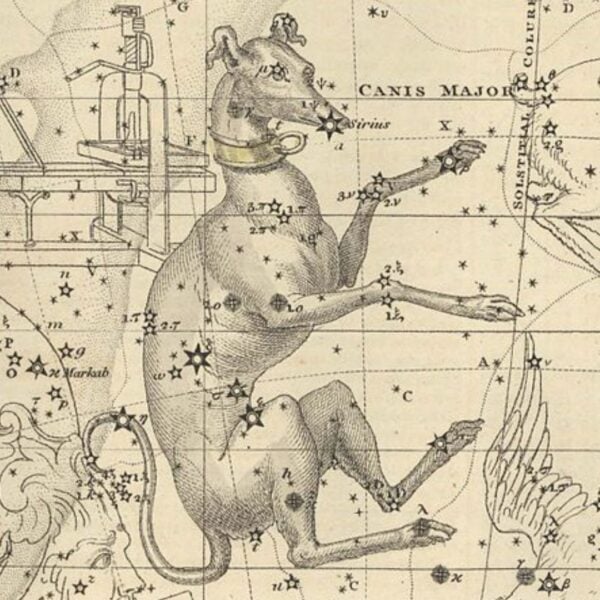
Sirius is known as the Dog Star because it marks the nose of the Canis Major (Greater Dog) constellation.
You made it to the end, congratulations! You have officially travelled from our tiny corner of the universe to the edge of what humans can explain.
Now tell us, how did this list hit you? Tap one of the reaction buttons below to share your vibe, whether you felt amazed, mind-blown, or you’re still deep in thought in the best way.
If you still want more space facts, why not check out this list of 100 interesting space facts, where we go more in-depth into each fact! Thanks for reading!