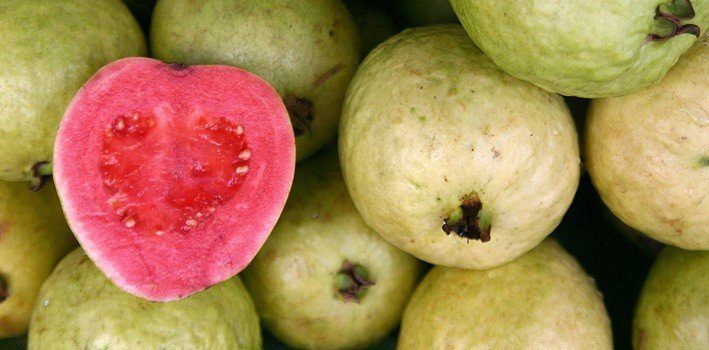
The guava is still to me quite a foreign and intriguing fruit.
The pink-fleshed jewel is supposedly the next “super-fruit” after packing quite the health-kick and as we all know this beauty has a delicious flavor.
Here we’re going to look at 15 facts about this strange little fruit.
Guava is used, in some form or another, to treat an array of ailments including fever, constipation and diarrhea, high blood pressure, hypercholesterolemia and dysentery.
Guava wood is prized in the world of meat smoking.
Guavas contain 4 times more fiber than a pineapple and 4 times more vitamin C than an orange.
Guavas are known for their seedy flesh. In the center of a guava there are between 100-500 edible seeds.
Guavas grow on 20 foot high evergreen shrubs, with white flowers. The leaves of the shrub are a source of black pigment used in textiles.
The lifespan of a plant is 40 years.
The young guava leaves are boiled to make a tea to cleanse wounds.
The origin of the guava is unknown, but unofficially the claim is made by Central America or Southern Mexico.
There are around 150 varieties of guava not just the green oval shaped fruit we all picture.
In El Salvador, the wood of a guava shrub is used to make hair combs.
India has over 27,000 tons of the pink guava every year.
Columbia has an ancient recipe using guava, the fruit is made into a paste and combined with cheese and eaten with Columbian bread. The concoction sounds awful but it supposedly scrumptious.
Guavas do a take a while to grow so don’t think in a year they’ll be flourishing! An average guava can take between 2 and 8 years to grow fully.
At one point in Philippine mythology the guava was forbidden. This changed when a child prayed to the gods to make the inedible fruit delicious so he could feed a beggar.
The largest guava plantation is in Brazil’s Dom Eliseu municipality.
As you can see there are numerous facts about this beautiful little fruit.
And the more you dig into the history and uses around the world the more wonders you reveal.
One things for sure, whatever the case, the guava is going to be even more popular as time goes on.
I’m sure as a result of this, the price will soon enough sky rocket.