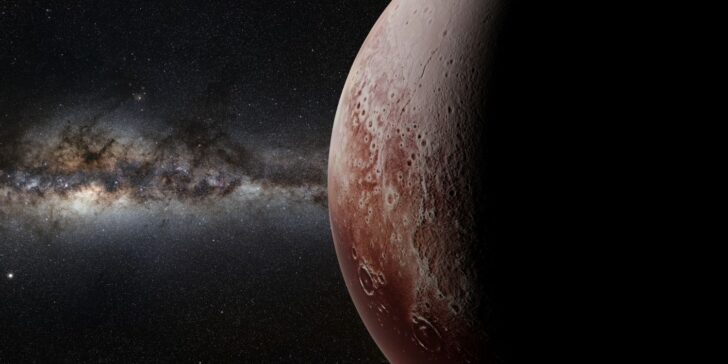
Pluto was the ninth planet in our solar system for 76 years, from its discovery in 1930, by Clyde Tombaugh, to its reclassification as a “dwarf planet” in 2006 by the International Astronomical Union (IAU).
The search for Pluto began much earlier, in 1906, when Percival Lowell founded an observatory to look for a potential ninth planet he called “Planet X.”
Lowell didn’t live to see the discovery of Pluto, and his wife’s ten-year legal battle with the Observatory over his legacy meant that the search for “Planet X” did not resume until 1929.
Unfortunately for Lowell, it has been proved that his “Planet X” never really existed, but the fictional planet’s orbit closely matched that of Pluto and directly contributed to Pluto’s discovery.
So what do we know about Pluto, and why isn’t it a planet anymore?
Pluto is a dwarf planet.
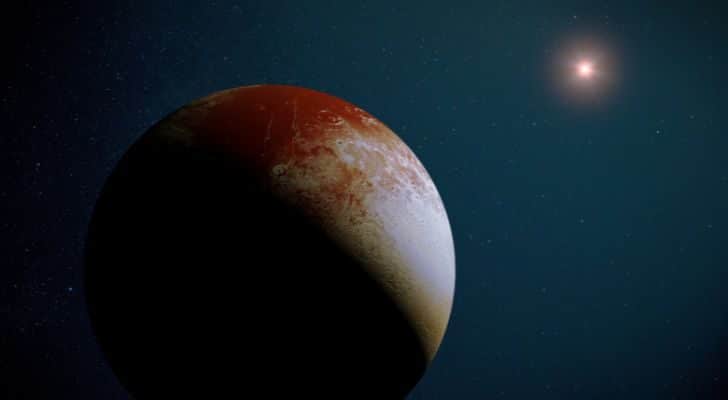
Pluto’s status as a planet had been questioned since 1992 after scientists discovered several other similar-sized objects in Pluto’s neighborhood.
On January 5, 2005, the dwarf planet Eris, which is 27% more massive than Pluto, was discovered, prompting the need for a new definition of the term planet.
In 2006 the IAU created an official definition that means a “planet” must meet three conditions:
- It must orbit the Sun.
- It must be large enough that its own gravity rounds it into shape.
- It must have “cleared the neighborhood” around itself, leaving no other bodies comparable in size in its orbit.
Pluto does not meet condition three. Keep reading to find out why!
Pluto is part of the Kuiper Belt.
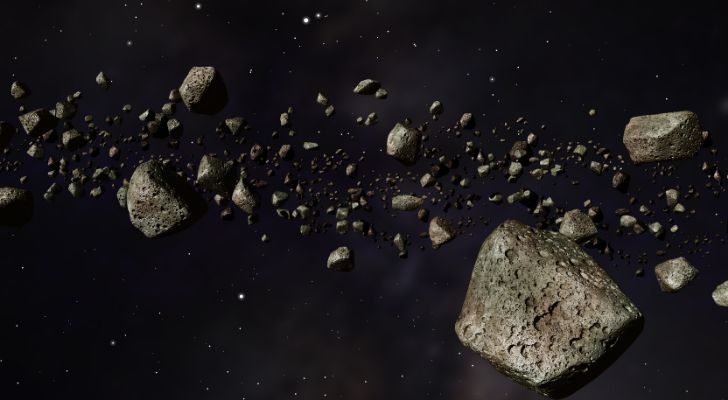
The Kuiper Belt is a circumstellar disc that sits just beyond the orbit of Neptune.
It is made up of icy “Kuiper Belt Objects” (KBOs), the first of which was discovered in 1992 and named Albion.
There are thousands of known KBOs, but hundreds of thousands are believed to exist.
There are a number of dwarf planets in the Kuiper Belt, including Haumea, Makemake, and Pluto, of which Pluto is the biggest.
Pluto is sometimes known as the “King of the Kuiper Belt,” but its real name, as of 2006, is 134340 Pluto.
Pluto has a twin!
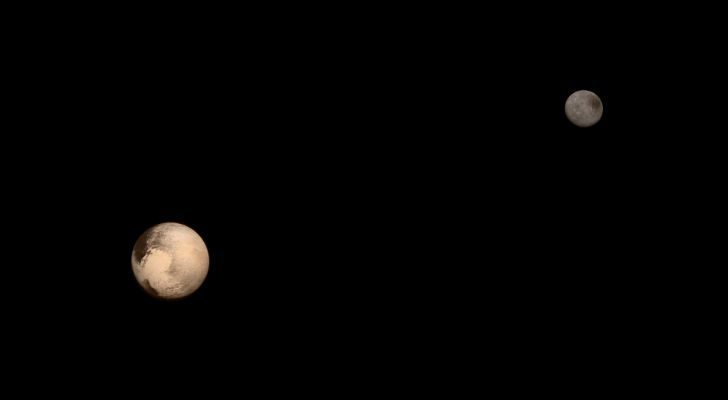
Pluto has five known moons: Charon, Nix, Hydra, Kerberos, and Styx.
The largest of these, Charon, is half the size of Pluto itself and remains tidally locked to Pluto at all times.
This means that the same sides of Pluto and Charon are always facing each other, which, combined with Charon’s size, led many scientists to refer to them as a “double dwarf planet.”
Charon is also Pluto’s only spherical moon; the other four are small and irregularly shaped. The largest moon is Hydra, at an estimated 32 miles (51 kilometers) in diameter.
Pluto is the tenth-most-massive thing in our Solar System.
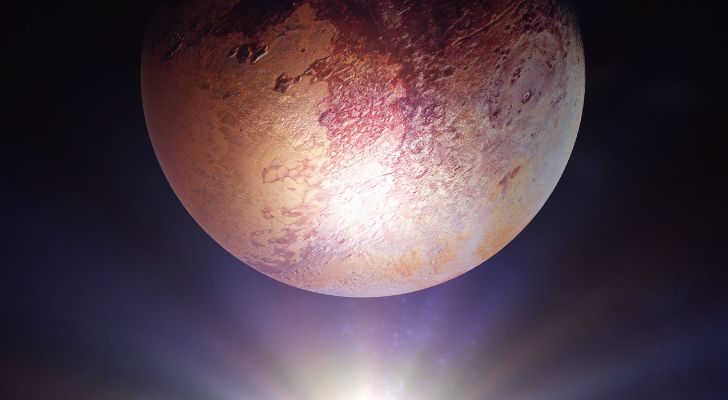
Pluto, with a radius of 715 miles (1,151 km), is only half the width of the United States.
Yet it still boasts the title of ninth-largest thing in our solar system and the tenth most massive thing.
When scientists refer to an object as “massive,” they are referring to its weight and density.
Pluto is made up mostly of ice, which is less dense than rock, which is why Pluto is less massive than it is large.
The ninth most massive object in our Solar System is Eris, the dwarf planet whose discovery prompted the reclassification of Pluto to dwarf planet.
Pluto is larger than Eris, but its mass is 27% less because Pluto has a small rocky core covered in a thick mantle of water ice. This ice mantle is far less dense than the rocky materials that Eris is made up of.
Pluto’s orbit is oval, not circular.
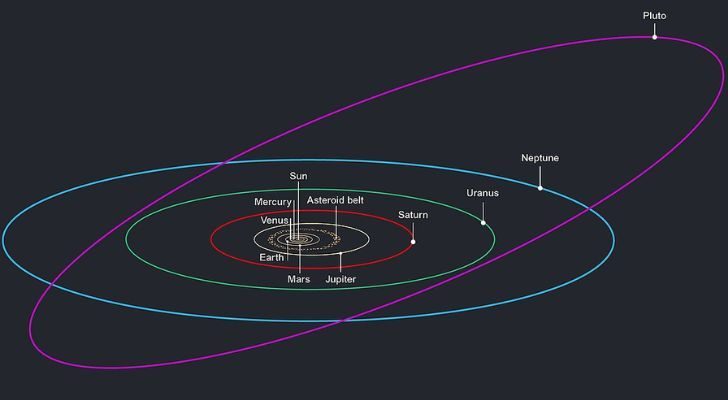
Pluto’s orbit takes it higher over the plane of our Solar System than any of the planets. The eight planets orbit the Sun in a fairly flat, circular formation, whereas Pluto’s orbit is tilted at 17°.
Pluto’s orbit is eccentric, meaning it travels in an oval form around the Sun, rather than a circle. This means that periodically, Pluto is closer to the Sun than Neptune.
Pluto has a literal heart of ice.
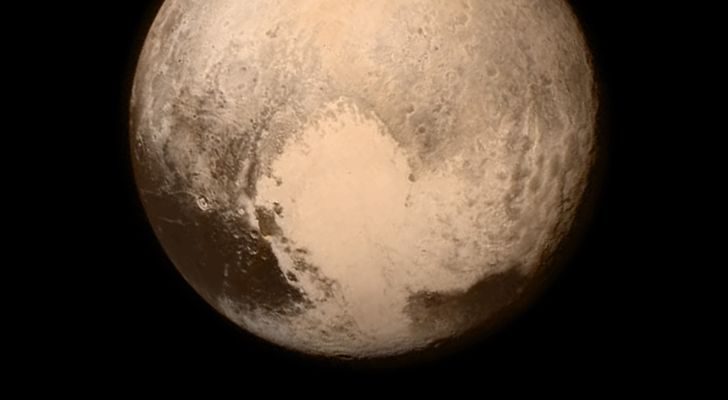
On July 14, 2015, the New Horizons spacecraft became the first spacecraft to fly past Pluto, using the gravity from Jupiter in order to reach the distant dwarf planet.
This gave scientists a chance to see the surface of Pluto more clearly than ever before.
Visible on the dwarf planet is a pale, heart-shaped formation called the Tombaugh Regio.
The Western half of the “Heart,” Sputnik Planitia, is a 621-mile (1,000 km) wide basin of frozen nitrogen and carbon monoxide.
The Eastern half of the “Heart” contains mountains made of water ice that reach up to 11,000 feet (3.35 km) high.
A year on Pluto is 248 Earth years long.
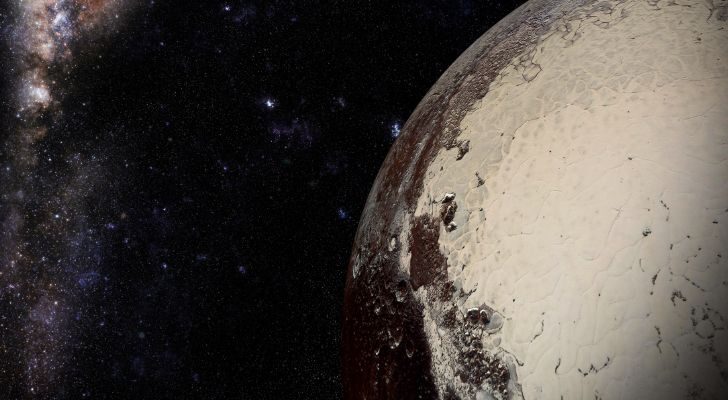
Pluto is usually 3.7 billion miles away from the Sun, or 39 astronomical units (AU). 1 AU is the average distance between Earth and the Sun.
This vast distance means it takes 248 Earth years for Pluto to complete a single orbit.
This means that in the 76 years that Pluto was classed as a planet, it never completed a single orbit around the Sun.
Oh, and one day on Pluto is the same as 153 hours (6.39 days) on Earth.
Pluto was named by an 11-year-old girl.

Venetia Burney, a young English girl with a keen interest in space and classical mythology, suggested the name Pluto after the Roman God of the Underworld.
She suggested it to Falconer Madan, her grandfather and former librarian at the University of Oxford.
Madan passed the name along to astronomy professor Herbert Hall Turner, who was so impressed with it that he sent it along to the Lowell Observatory, where Pluto was first discovered.
The name was ultimately put to a vote, with the staff at the Observatory choosing between 3 different names: Minerva, Cronus, and Pluto. Pluto received all the votes.
And little Virginia got £5 from her grandfather, which is roughly US$400 (£300) in today’s money.
Pluto gets foggy in summer.

The surface of Pluto is ice, mostly nitrogen ice and carbon monoxide ice, with a few water-ice mountains dotted around.
When Pluto is closest to the Sun, the ice on its surface sublimates (a process that causes solid matter to turn directly into gas) into hazy gases, causing layers of fog to rise up and create a thin atmosphere around the planet.
Surprisingly, Pluto is not that dark.
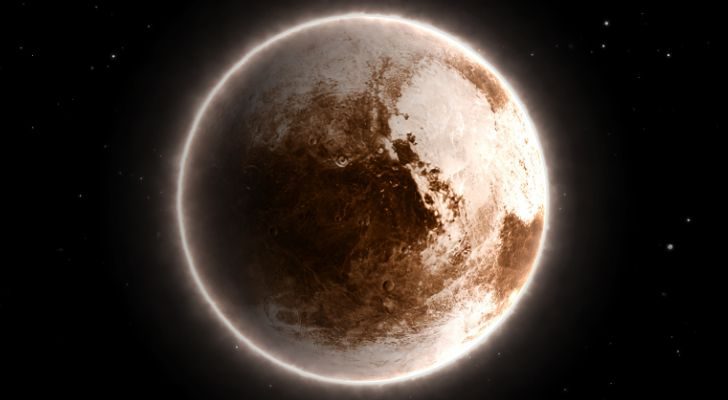
The Sun shines at around 1/900 the brightness on Pluto as it does on Earth, with the light taking 5 hours and 28 minutes to travel from the Sun to Pluto’s surface.
In comparison, it takes the Sun’s light only 8 minutes to reach us here on Earth.
From our beloved ninth planet to the double-dwarf planet boasting the tenth-largest mass in the solar system, Pluto has been on a slow roller coaster ride since we’ve known about it.
Scientists have managed to witness mountains, ice plains, and even weather conditions along its surface.
Since its reclassification to dwarf planet in 2006, we have learned more about Pluto and its surface than in the 76 years it was a planet.
Even Pluto’s neighborhood, the Kuiper Belt, has been identified and studied directly as a result of Pluto’s existence.